
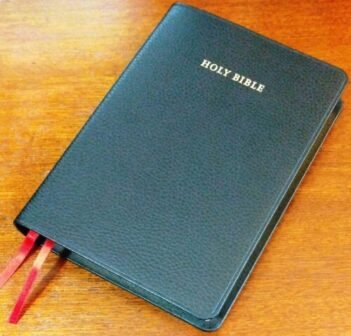
This month (June 2026) Cambridge University Press will publish the Diadem Reference Edition of the New Revised Standard Version Updated Edition (NRSVue), both with Apocrypha and without Apocrypha. The NRSVue provides more clarity in language and up-to-date consideration of critical texts to make this “a readable and accurate version of the Holy Bible to the global English-speaking community for public worship and personal study, for scholarship and study in classrooms, and for informing faith and action in response to God” (from “To The Reader”).
I received my copy of the New Revised Standard Version Updated Edition (NRSVue) Diadem Reference Edition in black calf split leather, and it is a stunningly beautiful Bible in every way. The look, the feel, and even the initial aroma (like a new pair of shoes) signal quality appropriate for this sacred text that will guide you in your walk with the Master. The black grained leather is elegant, paired with the gold gilt edges of the Bible pages. Two red ribbon markers finish it off.
My Bible also includes the Apocrypha. Cambridge University Press publishes the NRSVue Diadem Reference Edition both with and without the Apocrypha.
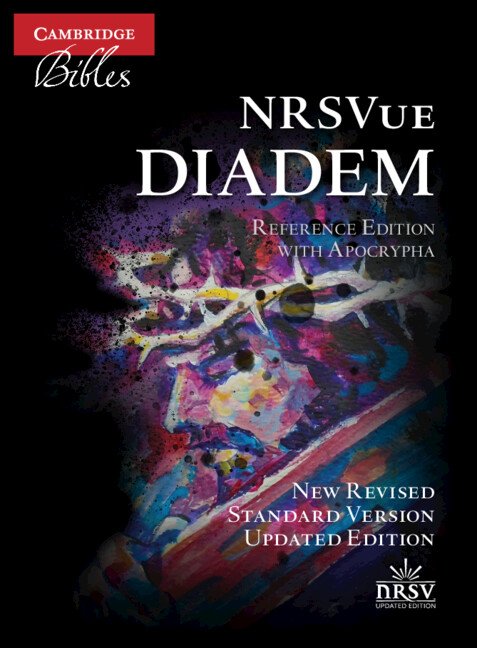
New Revised Standard Version
Updated Edition
Diadem Reference Edition
with Apocrypha
Cambridge University Press
June, 2026
www.cambridge.org/bibles
Buy from Amazon
Besides black, the NRSVue Diadem Reference Edition is offered in a variety of colors in calfskin and calf split leathers. Cambridge University Press provides a detailed description of the various leather bindings offered for their Bibles here.
The Diadem Reference Edition is a comfortable, mid-sized Bible measuring about 6.375” by 8.75” (160mm by 220mm). I’m just using a ruler, as I didn’t find the actual size of the cover posted. The page size is listed as 149mm by 212mm, or about 5.875” by 8.375”. Unused, right out of the box, mine measures 1.25” (32mm) thick. It came in a nice gift box, 6.75” by 9.25” by 1.50”.
The Bible text is in easy-to-read paragraph format, with two columns per page and a center column for cross-references. On the printed page, the text columns are about 2.125” wide and the center column reference is about 0.625”, so the outside margins are pretty small with not much room for notes if you like to write in your Bible (personally, I don’t do that).
Cambridge describes the pages as “high quality India-style paper.” It is thin but feels very strong and is fairly opaque. The justified Bible text is line-matched, meaning the lines are located in the same position on both sides of the page to prevent shadowing and bleed-through. It is comfortable to the eyes, described on the publisher’s website as 8.1-point Lexicon, though a page in the Bible itself says it is “8.2 pt. on 8.5 pt. Lexicon No.1A.” That description means there is a greater space between each line than normal for the font size, making it even more readable.
It is black-letter text (as opposed to a red-letter edition with the “words of Christ in red”), which is by far my preference for Bible reading. I mentioned the paragraph format, which of course was not present in the Greek manuscripts (neither was punctuation) but is very helpful when reading in English. The Diadem Edition also includes pericopes, those headings that are not part of the text of Scripture but make finding passages much easier. They are shown in italics.
Previously I reviewed the NRSVue text edition, which used the British (Anglicized) text. This Diadem Reference Edition is an American English text.
Cross References and Footnotes
The cross-references in the center are designated by verse, but they are not indicated within the text itself. It is easy to find and coordinate them from the center column, and not having an overabundance of superscript characters in the text makes it much less cluttered and easier to read. I find that to be a great improvement over other editions I’ve looked at. Most of the time when you are reading you aren’t looking for a cross-references to other passages that may or may not be relevant to your current study.
There are cross-references in the Apocrypha both to other books of the Apocrypha as well as the Old and New Testaments. However, I did not find any cross-references in either the Old or New Testaments to passages in the Apocrypha.
Footnotes, on the other hand, are very important to study. Variations in the text or alternate meanings in translation are an integral part of the New Revised Standard Version Updated Edition, and those are specifically designated by superscript alpha characters within the verse at the relevant point. Footnotes are printed at the bottom of the right-hand column on the page and are also designated with the verse number.
Both cross-references and footnotes are in a smaller typeface. I couldn’t find any indication from the publisher as to what size they are, but as expected they are quite a bit smaller. Verse designations for the cross-references are bold, and in both the cross-references and the footnotes they are in a somewhat unusual format using a period (.) rather than a colon (:).
This is a scanned image of a passage from Mark, chapter 6:
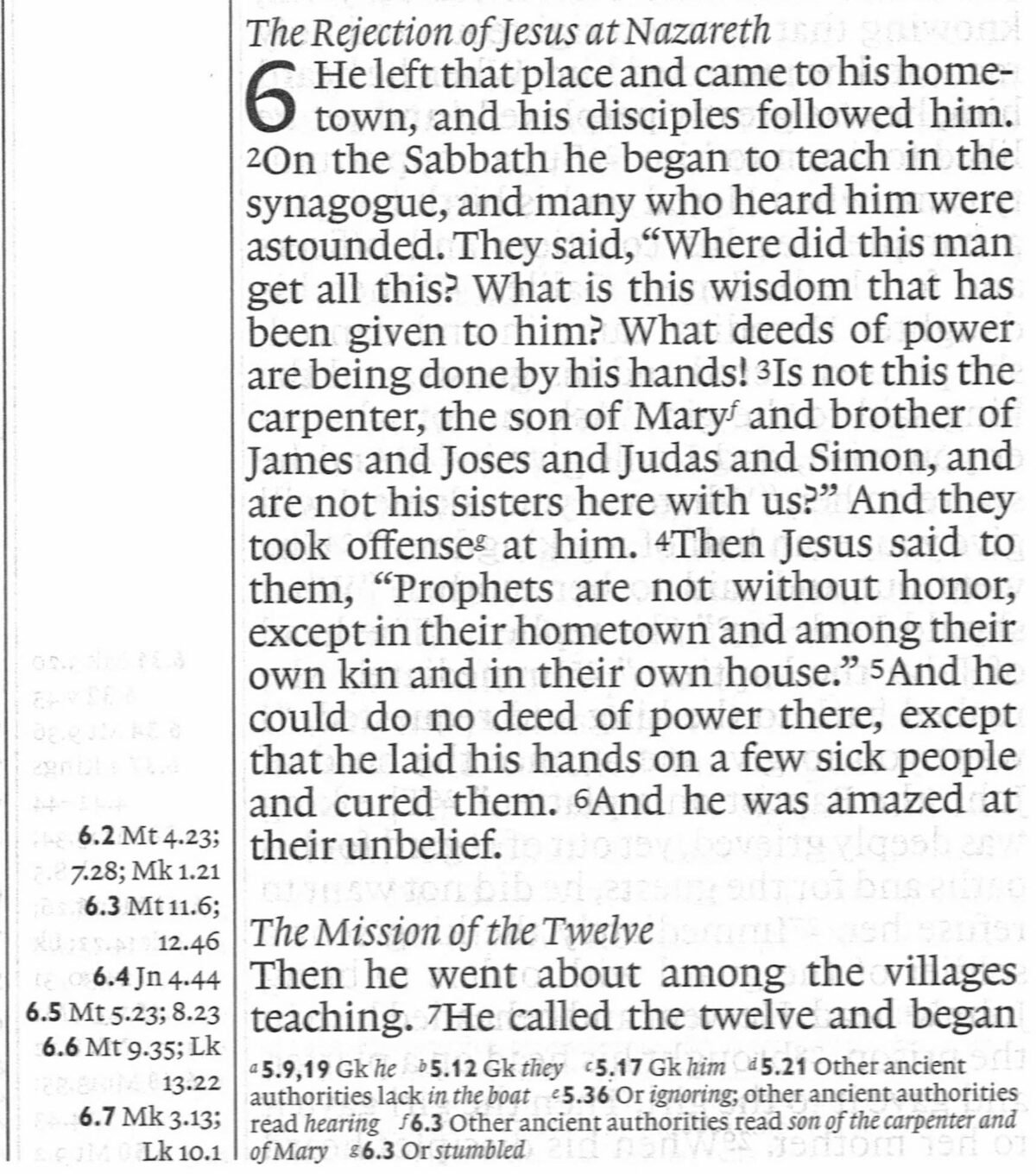
- “Rejection of Jesus at Nazareth” and “The Mission of the Twelve” are pericopes, not part of the Bible text, and are printed in italics.
- Cross-references are listed in the center column, designated by chapter and verse in bold type (e.g., 6.2; 6.3; etc.). Cross-references are not identified in the Bible text itself.
- All footnotes for the page are at the bottom of the right-hand column (shown here) and are designated by chapter and verse in bold (e.g., 5.9,19; 5.12; etc.). Footnotes are indicated in the Bible text by a superscript alpha character (e.g., f and g in verse 3 above).
- Notice that the chapter and verse designations are separated by a period (.) rather than a colon (:)
The titles found in many of the Psalms, which are part of the Hebrew text, are at the beginning of the appropriate Psalm. In Hebrew Bibles, this is often the first verse of the Psalm. It really bugs me when Bible translations leave these out. In this case, Psalm 53 has both a pericope (in italics) that is not part of the Hebrew Bible, and a title (in small caps) that is actually the first verse in the Hebrew Bible.
This is a scanned image of a passage from Psalm 52 and 53:
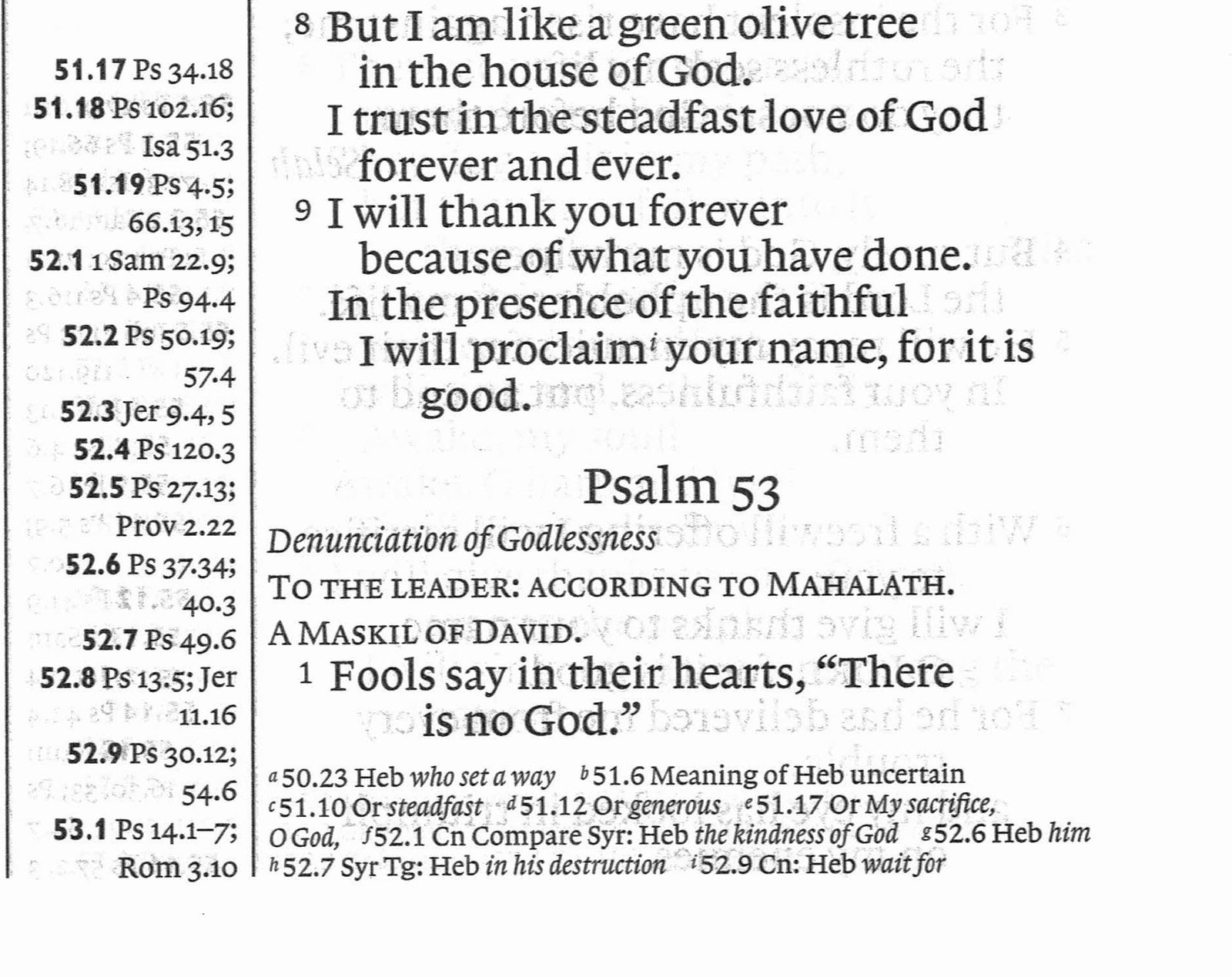
- “Denunciation of Godlessness” is a pericope, not part of the Bible text.
- “To The Leader: According to Mahalath. A Maskil of David.” is a title and is part of the Hebrew Bible text. This is the first verse of the Hebrew Bible.
- Notice also the use of cross-references and footnotes as described above.
Concordance and Maps
The layout of the NRSVue concordance is easier to read and much improved over most others I have seen. It is arranged in two columns on each page.
This is a scanned image of a portion of the NRSVue Concordance:
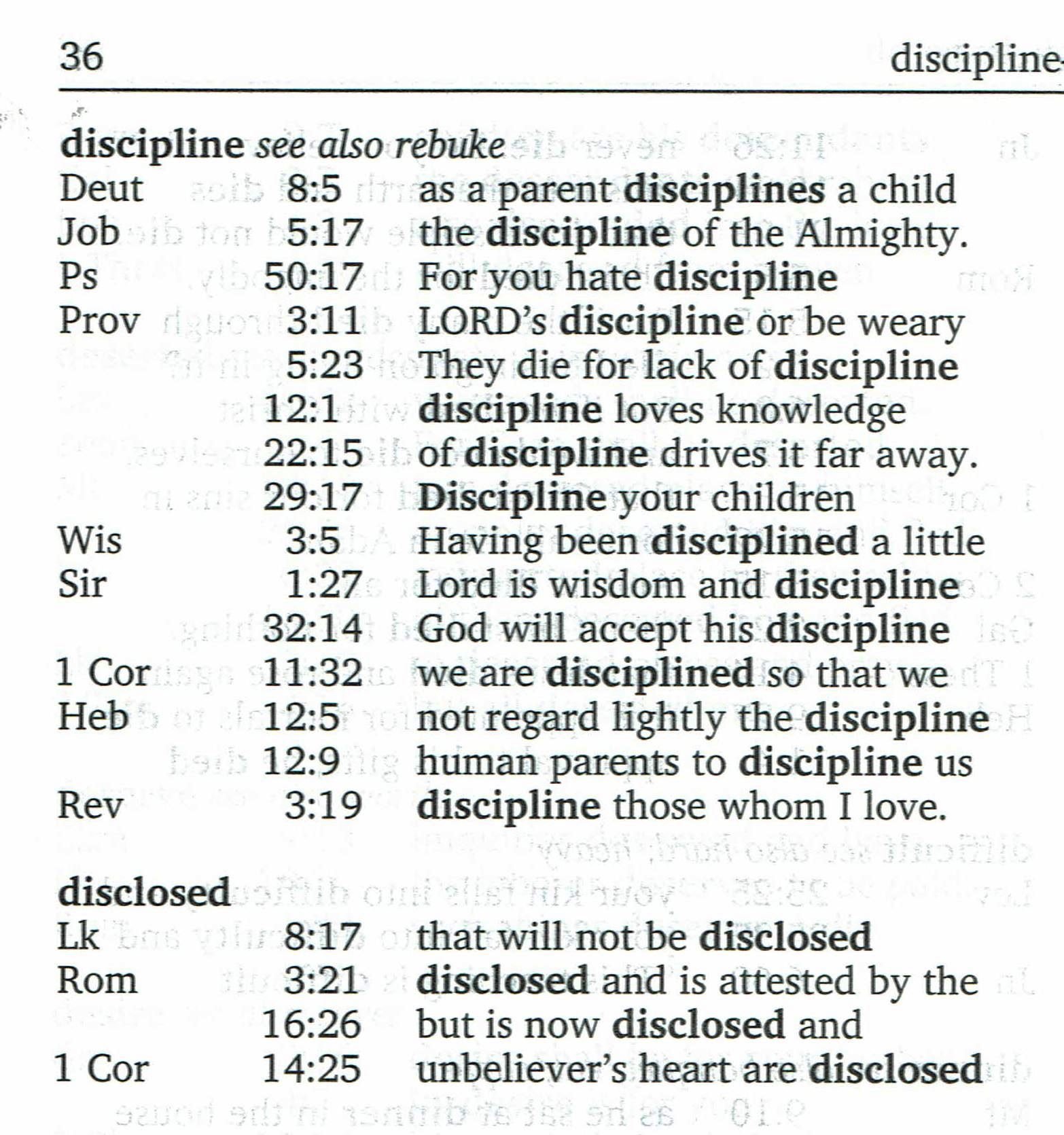
This concordance is, of course, not exhaustive, but it is extensive – 149 pages. Cambridge says there are 16,000 references, which sounds reasonable at just under 110 per page. This Bible is the NRSVue with Apocrypha, and the concordance includes limited reference entries for the books of the Apocrypha (note the references in Wisdom and Sirach in the image above).
Following the concordance are fifteen color maps preceded by an eight-page index to the maps. There are ten Old Testament maps and four New Testament maps, including one each of Old Testament and New Testament Jerusalem. There is also a map of the Hellenistic World of Alexander (time between the Testaments). Both the index and the maps are printed on heavier glossy paper. They are the last pages of this volume.
Because this is the New Revised Standard Version Updated Edition with Apocrypha, there is a section of “maps relevant to the Apocryphal/Deuterocanonical books” following the Apocrypha, which appropriately is placed between the Old and New Testaments. These maps are in black and white and are printed on the same paper as the Bible pages so you don’t have any heavy, stiff pages in the middle of your Bible. They cover four pages, and there is no index provided for these maps.
At the beginning of the NRSVue Diadem Edition are Presentation and Family Record pages. These are printed on heavier paper, similar to the maps but without a glossy finish, making them suitable for writing. Then on “Bible” paper are the title page, Table of Content, Preface and other introductory items you would expect to see. Of interest to me is a table showing a Chronology of Rulers including the Hasmonean period, appropriate for a Bible that contains the Apocrypha.
The New Revised Standard Version Updated Edition
The New Revised Standard Version (NRSV) was first published in 1989 as an update of The Revised Standard Version (RSV). The National Council of Churches of Christ in the USA (NCC), which holds the copyrights, commissioned the Society for Biblical Literature (SBL) to produce the New Revised Standard Version Updated Edition (NRSVue), described on the title page as © 2021. This Diadem Edition of the NRSVue, published by Cambridge University Press, is dated 2026.
In “To The Reader” the NCC states, “The NRSVue extends the New Revised Standard Version’s (NRSV) purpose to deliver an accurate readable, up-to-date, and inclusive version of the Bible.” It also states, like the NRSV, that the Bible’s message “must not be disguised in phrases that are no longer clear or hidden under words that have changed or lost their meaning; it must be presented in language that is direct and plain and meaningful to people today.”
The Society for Biblical Literature stresses the commitment not to turn this into a new translation. It identifies two primary types of revisions for this update: Text-Critical Revisions and Philological Revisions. The following is taken from my previous review of this translation:
Text Critical Revisions – The NRSVue Old Testament continues to use the Masoretic Text as its base. This should not be surprising, given the commitment not to make a new translation. There are, however, recent discoveries of ancient manuscripts that shed new light on some texts. And even though it isn’t “recent” or “new,” awareness and use of the Septuagint has increased as well, perhaps due to a rapid rise in electronic formats and their accessibility. The last line of this quote from the preface is particularly telling.
Since the Dead Sea Scrolls and the Septuagint translation predate the Christian era, they present for certain books an earlier and more original version in the development of the texts. Each of the versions was considered authoritative by a community. This advance in textual scholarship is recent, however, so the NRSVue retains for its translation the version presented by the Masoretic Text, whether it attests to the earlier, parallel, or later version. The differences between these major versions are larger than can be added to the notes.
Preface to the NRSV Updated Edition
NRSVue New Testament books are translated from the United Bible Society The Greek New Testament, 5th revised edition) and others. This is pretty standard with most of the modern translations. Interestingly, the Preface notes, “care was taken not to push too far ahead of the existing critical editions or to turn the translation itself and its notes into a critical edition.”
Philological Revisions – Word changes in the NRSVue were necessary so that terms in modern English, which is itself changing, accurately reflect the meaning of the ancient languages. I think some of these changes will be welcomed by Messianic and Hebrew Roots readers.
The NRSVue took special care not to use terms in ways that are theologically or historically anachronistic, though, as in every translation, anachronism is unavoidable.
From the Preface to the Apocryphal/Deuterocanonical Books of the NRSV Updated Edition
No doubt there will be criticism because of “gender inclusive” language. It is probably better to say “gender accurate,” or just “accurate,” language. The NRSVue has made this a little more consistent than the NRSV, as seen by the translation of adelphoi discussed later.
You can read my complete review of the NRSVue at https://messianiclight.com/nrsv-updated-edition-bible-review/
The NRSVue Apocrypha
The books of the Apocrypha in the NRSVue are situated between the Old and New Testaments. Even though some of the books of the Apocrypha are listed as “Deuterocanonical,” they are not intermingled with the books of the Hebrew Bible as they are in Catholic editions. The Table of Contents lists 18 books. Page numbering in the Diadem Edition begin at 1 for Genesis, start over again at 5 for Tobit, the first book of the Apocrypha (allowing for three blank pages and a title page first). Page numbering starts over again for Matthew in the New Testament.
The NRSVue Apocrypha includes the 12 books or additions to books found in the Roman Catholic Deuterocanon plus 6 additional books (1 Esdras, 2 Esdras, Prayer of Manasseh, Psalm 151, 3 Maccabees, 4 Maccabees) from Greek and Slavonic Bibles. These are the same 18 books that have always been part of the Revised Standard Version family.
There are two (at least) different Greek versions of the book of Tobit. The NRSVue Apocrypha uses the longer version, also taking into account the Dead Sea Scrolls and other ancient writings. The complete text of the Greek version of Esther is presented in the Apocrypha section. There are variations from what is found in the canonical Esther from the Hebrew text.
As mentioned earlier, the Apocrypha has its own small section of maps appropriate to the time period.
It is important for serious Bible students to read the Apocrypha, especially the historical narratives that cover the rise of Hellenism in Israel and the Hasmonean Dynasty. While the Old Testament tells of Israel up to the Babylonian captivity, there are only a brief few chapters that cover the return and almost nothing about life in post-exilic Judea. Reading these accounts in the Apocrypha sets the groundwork for understanding Second-Temple Judaism in New Testament times.
You can read my complete review of the NRSVue Apocrypha at https://messianiclight.com/nrsv-updated-edition-apocrypha/
Conclusion
The Cambridge Diadem Reference Edition of the New Revised Standard Version Updated Edition brings an accurate, contemporary translation together with essential reference tools in an elegant and sophisticated Bible for worship and study. This is a beautiful choice as a cherished gift or as an investment in your personal devotions.